Alternatives to Knee and Hip Replacement: What Actually Works
Surgery Center Directory Team
May 1, 2026
Not everyone with knee or hip pain from arthritis needs, or wants, a joint replacement right away. A range of non-surgical treatments — from physical therapy to injections to regenerative medicine options like PRP and stem cell therapy — are widely available and, in some cases, genuinely effective. They're also widely marketed in ways that overstate what the evidence actually supports. Here's an honest breakdown of what each option does, what it doesn't, and when it makes sense to try one before considering surgery.
Physical therapy and weight management: unglamorous, but genuinely effective
Before any injection or procedure, physical therapy focused on strengthening the muscles supporting the joint is one of the best-evidenced interventions for mild to moderate osteoarthritis, and it's frequently skipped or under-tried before patients move on to more expensive options. For weight-bearing joints specifically, even modest weight loss meaningfully reduces the mechanical load on the joint and has real evidence behind it for reducing pain and slowing progression.
Neither of these is exciting, and neither is marketed the way injections are, which is part of why they're underused relative to how effective they actually are for earlier-stage arthritis.
Corticosteroid injections: fast relief, limited duration
A corticosteroid (cortisone) injection into the joint reduces inflammation and can provide meaningful pain relief, often within days. The relief is typically temporary — commonly weeks to a few months — and repeated frequent use is generally limited, since there's some evidence that frequent cortisone injections may accelerate cartilage breakdown over time. It's a reasonable short-term tool, particularly to get through a specific event or buy time, but it's not a long-term solution and doesn't address the underlying joint damage.
Hyaluronic acid injections: modest evidence, mixed results
Hyaluronic acid (viscosupplementation) injections aim to supplement the joint's natural lubricating fluid. The evidence for meaningful benefit is mixed — some patients report real relief, but multiple large studies and reviews have found the effect to be modest at best compared to placebo for knee osteoarthritis specifically, and some major medical societies have downgraded their recommendation for its routine use as a result. It's not fraudulent or unreasonable to try, but it's worth going in with realistic expectations rather than assuming it works as reliably as marketing suggests.
PRP (platelet-rich plasma): real evidence, most effective earlier
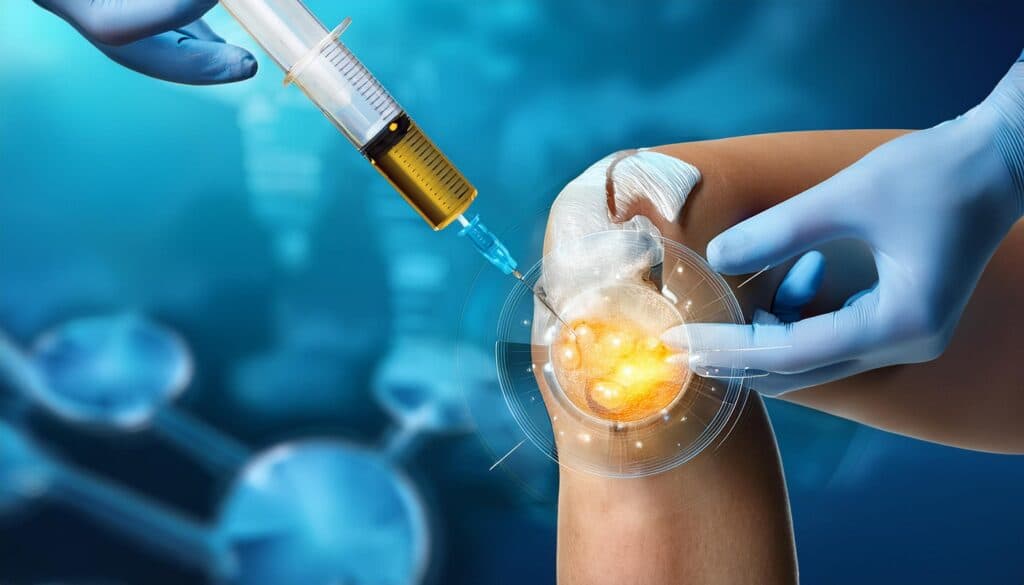
PRP involves drawing a small amount of the patient's own blood, concentrating the platelets, and injecting that concentrate into the joint. The idea is that platelets release growth factors that reduce inflammation and support tissue repair. The evidence here is genuinely more supportive than for hyaluronic acid — several studies and meta-analyses show meaningful pain and function improvement, particularly for early to moderate osteoarthritis (mild to moderate cartilage loss, not bone-on-bone).
PRP is not covered by most insurance and is typically a cash-pay treatment, often several hundred to over a thousand dollars per injection, sometimes requiring a series. It also doesn't reverse existing structural joint damage — it's best understood as reducing pain and inflammation and possibly slowing progression, not regenerating lost cartilage in any dramatic sense. For advanced, bone-on-bone arthritis, the evidence for meaningful benefit is considerably weaker.
Stem cell and bone marrow concentrate (BMAC) therapy: promising, but less standardized
Stem cell therapy for joints in the U.S. typically uses the patient's own cells, most often harvested from bone marrow (BMAC) or, less commonly, fat tissue, rather than embryonic or donor stem cells. Some research suggests stem cell-based treatments may have a higher potential benefit than PRP for moderate osteoarthritis specifically, though the field is less standardized — protocols, cell concentrations, and processing methods vary considerably between providers, which makes comparing outcomes across studies and clinics genuinely difficult.
Cost is typically higher than PRP, often several thousand dollars, and also not covered by insurance in most cases. As with PRP, it's not a replacement for a joint that's already severely damaged — the appropriate candidate is someone with earlier-to-moderate arthritis, not someone who's already bone-on-bone.
Peptides: real research, but a different category entirely
Peptides like BPC-157 are sometimes marketed as regenerative or healing-support options for joint and tendon issues. There is real preclinical research behind some of these compounds, but they occupy a meaningfully different regulatory and evidence category than PRP or stem cell therapy — they are generally not FDA-approved for these uses, are typically sourced through compounding pharmacies rather than standard prescription channels, and lack the kind of large clinical trial evidence that supports PRP or BMAC for joint conditions. Anyone considering peptide therapy should treat it as a distinctly different risk category and have that conversation directly with a physician rather than sourcing it independently.
When these options make sense, and when they don't
Non-surgical and regenerative options are most reasonable for patients with mild to moderate joint damage who want to delay surgery, reduce pain in the meantime, or who aren't good surgical candidates for other health reasons. They are not a substitute for replacement in patients with advanced, bone-on-bone arthritis and significant functional limitation — at that stage, the evidence for meaningful benefit from any of these options drops considerably, and delaying an appropriate surgery can mean more months or years of unnecessary pain and reduced mobility.
The honest way to approach this decision is with imaging (X-rays showing the actual degree of joint damage) and a direct conversation with an orthopedic surgeon about where your specific joint falls on that spectrum — not by choosing a treatment based on marketing and hoping it applies to your situation.
Related Resources
Looking for a surgery center near you?
Search 5,700+ Medicare-certified ASCs and compare CAHPS scores, accreditation, and patient reviews.